Ethos
Our common futureThe wherever-you-need-it table
In 1987 the Brundtland Commission defined sustainability:
"Sustainable development is development that meets the needs of the present without compromising the ability of future generations to meet their own needs."
Yet everything we do in our lives seems to have a negative impact on the world around us. What are we to do?
How about creating products that are avowedly long-term in their outlook?
Products that do not strive for built-in obsolescence but prefer to be discreet, adaptable and faithful servants in the face of a turbulent world. Products that minimise their inevitable impact on the world’s environment and resources by being useful for as long as possible.
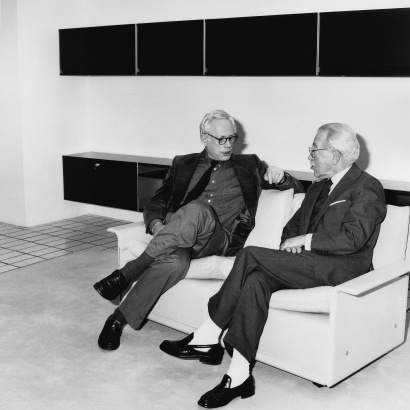
This was Vitsœ’s proposition in 1959: to eschew fashion whilst creating products that would be the blank canvas on which to paint your colourful life.
After more than 65 years our resolve is stronger than ever: more of us must learn the art of living better with less that lasts longer.
True system-thinkingTrue system-thinking
Vitsœ's products are designed as true systems with high-quality specification and finishes to ensure flexibility, adaptability, durability and therefore, longevity.
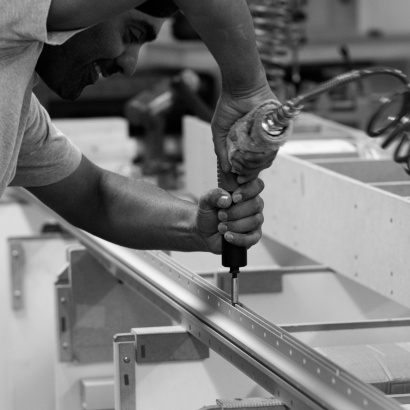
A true system is simple to construct, evolve, repair and dismantle. Most Vitsœ furniture comprises recyclable aluminium, steel and compostable wood that is assembled with mechanical joints (ie, not bonded or welded) to permit repair and end-of-life dismantling.
Importantly, any item is designed and built to last as long as possible.
Reusing rather than recyclingReusing rather than recycling
Vitsœ generates as little waste as possible at all times and in all areas of its business. Reuse is the Vitsœ touchstone. For example, wooden stillages are used to transport our aluminium parts between suppliers. Many stillages have been in continuous use for 20 years.
But reuse also applies to customers who are able to take their furniture from home to home while adding, subtracting or dividing as necessary.
Coincidentally this means that Vitsœ costs you less than cheaper alternatives.
Consuming lessConsuming less
Every new customer for Vitsœ is another customer who will consume and dispose of less during their lifetime. Some observers are perplexed by Vitsœ’s desire to sell less of its self-effacing furniture to more customers and to encourage them to live with it for longer.
It was the Stern Review of 2006 that said: “The world does not need to choose between averting climate change and promoting growth and development.” Vitsœ can grow because of its ethos.
No commission; honest pricing; no salesNo commission; honest pricing; no sales
You can buy less today because you can return tomorrow for help reconfiguring, re-planning or moving your existing furniture.
Accordingly we do not earn commission because that rewards short-term thinking.
We charge all our customers a single, fair, honest price and we do not have seasonal sales because our stock does not become obsolete.
Our founder, Niels Vitsœ recognised this when he said, “Our happiest customers are those who have dealt with Vitsœ the longest.”
Learn more about our honest pricing