After almost half a century our resolve is stronger than ever: more of us must learn the art of living better with less that lasts longer


Mark Adams explains our ethos

“the concept is to reuse your furniture…we see recycling as a defeat”

Mark Adams
managing director, Vitsœ


Living better, with less, that lasts longer

It’s a funny old world. The realisation is dawning that just spending more time earning more money to buy more stuff that gives transient gratification is not necessarily the route to eternal happiness. The developed world is moving from scarcity to surfeit. The backlash must come.

Can we honestly continue to use everything for such a short period of time and then not feel a pang of guilt when we have to throw it away? That plastic cup for a single drink of water on the aeroplane; that 18 month-old printer that is cheaper to replace than repair; and the volumes of left-over packaging from your trip to the supermarket. What happens if/when the entire world adopts these habits? According to current thinking, we will need three planets to sustain us.

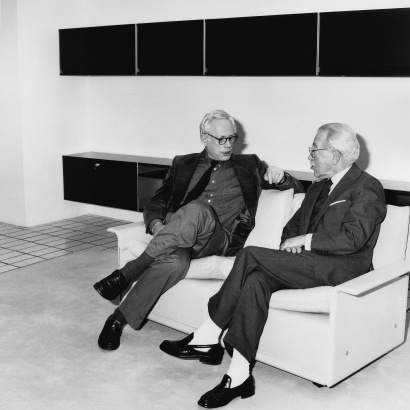
Ingeborg Kracht-Rams at Vitsœ’s showroom in Frankfurt, 1971


Sustainable development

In 1987 the Brundtland Commission defined sustainability:

“Sustainable development is development that meets the needs of the present without compromising the ability of future generations to meet their own needs.”

Yet everything we do in our lives seems to have a negative impact on the world around us. So, what are we to do?

How about creating products that are avowedly long-term in their outlook? Products that do not strive for built-in obsolescence but prefer to be discreet, adaptable and faithful servants in the face of a turbulent world. Products that minimise their inevitable impact on the world’s environment and resources by being useful for as long as possible.

This was Vitsœ’s proposition in 1959: to eschew fashion whilst creating products that would be the neutral canvas on which to paint your colourful life.

After almost half a century our resolve is stronger than ever: more of us must learn the art of living better with less that lasts longer.


Decisions for the long term

Vitsœ does not exist purely to make a profit. Yes, of course, Vitsœ must make a profit to survive – and Vitsœ watches the figures as closely as any company – but Vitsœ exists to give genuine satisfaction to its customers, suppliers and employees. If our customers are happy, we will make a profit. It’s that simple.

Therefore Vitsœ always takes decisions for the long term, to the benefit of everyone involved.

We try not be distracted by novelty or passing fashions and therefore produce a limited range of colours and materials. This not only helps us to ensure supply for the future but it helps our products fit in with their surroundings. Some have observed that we sell invisibility.


Reuse, then repair

At Vitsœ we concentrate on reuse; recycling is what you do when you fail to reuse. We expect you to call us to ask for help when reconfiguring, dismantling or moving your existing shelves.

Of course, we hope at Vitsœ that our products are good. But we are nothing unless our service is excellent. In many respects we are a service business that just happens to make a product.

You can return for spare parts, ask for your furniture to be repaired or even reupholster an entire chair in your own home after decades of use.

Vitsœ rarely takes part in trade exhibitions which increasingly seek to portray furniture as fashion and thereby exacerbate the problem of waste creation while seeking to satisfy short-term financial goals.

Vitsœ’s approach is, at first glance, not cheap; but when spread over only a few years it rapidly becomes cheaper for our customers and us, as well as being of great benefit to society.

Read the Atlantic magazine article – buy to last


Better design and use of materials

Vitsœ’s products are designed as true systems (the principle behind London’s long-lived Routemaster bus, also a product of post-war thinking) with high-quality specification and finishes to ensure flexibility, variability, adaptability, durability and therefore longevity.

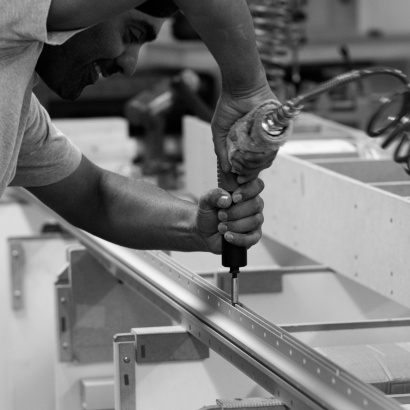
All of our products are simple to construct, repair and dismantle; the use of plastic is minimised; most products comprise recyclable aluminium and steel, and compostable wood that is assembled with mechanical joints (ie not bonded or welded) to permit repair and end-of-life dismantling.


Very little waste

Vitsœ produces very little waste; aluminium-extrusion offcuts go to recyclers as does waste cardboard at the end of its multiple-use life

Wooden stillages are used to transport all of our aluminium parts between suppliers; some of these stillages have been in continuous use for 15 years.


Reuse packaging

When suppliers deliver components, reused cardboard packaging and stillages are returned on otherwise empty vehicles for reuse; waste and costs are reduced.

Vitsœ’s demands for innovative packaging solutions are often ahead of developments in the market. For example, compostable starch packaging (in use at Vitsœ for ten years) is still greatly undervalued in the UK.

Where possible, we deliver our cabinets in reusable, repairable, heavy-duty ‘tautliner’ bags; the investment was off-puttingly great but the rewards were rapidly even greater than anticipated.

Incoming packaging from suppliers is reused as outgoing packaging for customers.

No waste whatsoever is left at your home or office when we install a shelving system; all packaging is returned for reuse.

Recently Vitsœ’s internal processes have been migrated to the web and have become almost paperless; you can order complicated shelving systems without having to use or receive any paper.


Obsolescence is a crime

Massimo Vignelli

I am not rich enough to buy cheaply

Anonymous


Floristic affinities exhibition at 72 Wigmore Street, London, 2005

Descent with modification

“Evolution: descent with modification”

Charles Darwin, 1809-1882

Nature does not hold annual trade exhibitions where it displays rafts of new products, many of which will disappear without trace almost immediately. Moreover, nature has no waste: all lifecycles are closed. Whereas man used to operate within closed cycles, during the 19th and 20th centuries the cycles became open and created waste.

Therefore the lessons are in nature: allow a species to evolve continuously via small, apparently insignificant, improvements while reusing every last molecule at end of life. Vitsœ tries to behave in this way.